

Swimwear brands
Bikini brand video ads: wet hair, a cover-up, and the cut you do not buy ads with
A swimwear label does not have a smell problem. It has a skin problem. The product is a small garment on an adult body, and every extra centimetre of thigh, every strand of wet hair, every open shirt reads as either a catalog or a dare. Buyers want the dare on the brand site. Ad platforms want the catalog. Most “bikini ad” pages pretend those are the same film.
Make a swimsuit clip with the suit fully on. You see the plan and the price before anything is generated.
They are not. This is the split: what to generate for the product page, what a 6 to 12 second lookbook can do, and what you delete before anyone spends money on TikTok or Meta. The suit stays on. Nobody is under 18. Blurbly’s swim tests were catalog and lifestyle stills, not a promise that a wet, slow, hip-led clip will pass review.
Blurbly editorial · · 6 min read
Start from the suit, or the video will invent one
Swimwear video fails in a specific way. The model “helps” by changing the cut. In Blurbly’s swimwear still test, a one-piece described as a bikini top came back as a bikini top. Words beat the photo. A video brief is worse, because motion gives the generator more chances to redraw straps, raise a leg opening, or swap a one-piece for a two-piece halfway through. Name the garment in boring words: one-piece or two-piece, strap width, where the leg opens, ribbed or smooth, print or solid.
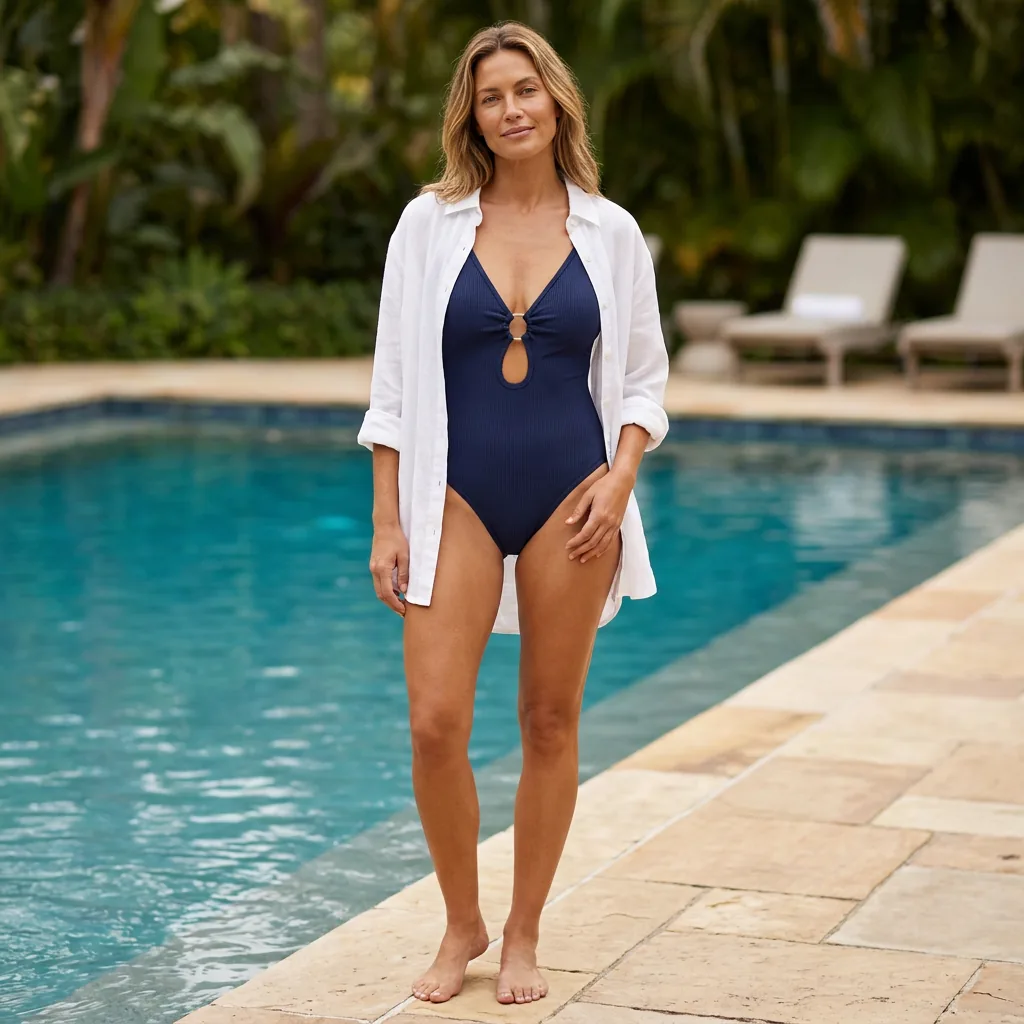
Upload a flat, front-lit photo of the real suit before you ask for water. Water, sunset and wet hair all shift colour. Keep one dry, neutral still as the colour reference and throw out any clip where the navy went teal. Prints move. A leaf pattern that is “the same kind of leaf” in a different place is a mood frame, not a product frame. The swimwear product photos page is where the still set belongs. This page is about the motion you add after those stills match.
Three moves that feel like a campaign and keep the suit intact
The pool-edge walk is the workhorse. An adult model, suit on, walks left to right along the water. A linen shirt or kaftan is open over the suit so you are selling a set, not a body. Arms hang or swing like a normal walk. The camera is at hip height only if the suit, not the hip, is the sharpest thing in frame. If the brief says “hips first” or “slow body roll”, you have left the campaign and entered the category TikTok names as sexualized position.
The calf-deep stand is the second move. Water to mid-calf, not to the waist, because waist-deep water plus a low camera becomes a groin shot the moment the model turns. Wet hair is allowed to look wet. It is not a reason to add a head toss on a beat. The third move is the dry turn: sand or studio, full suit visible, a quarter turn so the back strap and the front neckline both get a second. That dry turn is the clip you can actually pay to run. The wet ones are for the site hero and the retailer lookbook.
Wet fabric, oil and slow motion are the actual edge
Wet fabric clings, and clinging is the entire reason a swim ad feels charged. You do not need a pose on top of it. If the suit is already wet and the light is from the side, a plain stand reads as a campaign. Adding an arched back, a finger under a strap, or a hand pulling the suit away from the hip stacks a second suggestion on the first. That stack is what review calls sexually suggestive. One signal is a swim ad. Three signals is a different video.
Oil on the shoulder does the same job as water and costs you more platforms. Leave it off anything you might boost. Slow motion is a tool, not a mood. Use it for one second on the waterline or the shirt hem so the fabric reads. A four-second slow motion of a walk toward camera, shot from below, is a thirst cut. It will do well as an organic post from a creator who already has the audience, and it will do badly as the ad you need approved on a new account. The edgy brand ad shots page maps that difference across categories. Here, the rule is one charge at a time: wet, or close, or low angle. Not all three.
What TikTok and Meta have actually written down
TikTok’s adult content policy lists swimsuits, lingerie and clothing that exposes or implies exposure of intimate areas as sexually suggestive and not allowed, along with emphasis on sensitive body parts, sexualized positions, flirtatious movement and undressing. A bikini is not banned as a product. A bikini video that implies exposure, stares at the chest or groin, or includes a strap being pulled off, is the creative they describe. Read the policy before you brief the editor, not after the disapproval.
Meta’s adult nudity rules ban nudity, including “near nudity” hidden by a digital blur, and sexual activity. Swimwear can run, and Meta’s health and wellness standards even exempt swimwear and lingerie from one age-targeting rule, provided the ad does not violate the nudity policy. Suggestive poses and revealing clothing can still be limited to people 18 and older. “The suit is allowed” is not “this edit is allowed”. The swimwear ad policy page turns those sources into shoot notes. Nobody here, including Blurbly, can promise a green check.
A 12-second lookbook and a 6-second ad are different edits
Cut the lookbook for people who already clicked. Open on the dry full-length stand so the suit is identifiable, then the pool walk with the shirt, then one second of water at the calf, then back to the dry suit with the price or the colour name. No lyric with a sexual hook. No text on screen that winks. Twelve seconds is enough. Longer, and you start inventing story, and story in this category turns into flirtation because there is nothing else to do.
Cut the ad as if a stranger will see it with the sound off between two other videos. First frame: suit, front, sharp. Middle: the dry quarter turn. Last frame: suit plus the shirt, or the suit flat on a towel if you want zero body debate. The wet walk stays on the product page as a muted loop. If you only have budget for one export, export the dry one and put the wet one behind the email signup. The AI swimwear model photos page shows the still version of this split: catalog, pool, beach, cover-up, from one product photo.
Briefs that generate, and briefs that should be refused
A usable brief names an adult, the exact suit, the walk or the stand, the shirt if there is one, and the light. It says the suit does not change. It does not say “sexy”, “thirst”, “teasing” or “pull the strap”. Those words are how you get either a refusal from the image model or a clip you cannot advertise. Blurbly restricts nudity and sexual content. A declined swim frame is a safety check, not a verdict on your brand. Change the verb from a body verb to a garment verb and run it again.
Never brief a minor, a “young” body, a school setting, or a real customer’s photo unless that adult signed a release that covers synthetic media. Do not ask for the suit to come off, even as a joke in the last frame. Undressing is named in TikTok’s policy and it is outside Blurbly’s policy. If you sell kids’ swim, this article is the wrong genre. Use a flat lay and a mannequin. The charged moves above are for adult fashion only.
What to publish in the first week of a drop
Week one of a new colour is not the week to test how close you can get. You are still checking that the generator kept the strap and the print.
- Day one: white-background suit and one dry on-model still. Compare straps, leg line and colour to the sample in your hand.
- Day two: the 6-second dry turn for ads, sound off, end frame held.
- Day three: the pool walk with a cover-up, for the product page only. Watch for a suit change between seconds.
- Day four: email the list the dry still and a fit note. Fit notes sell swimwear. A slow hip shot does not tell anyone the torso runs small.
- Day five: if you buy Meta, start with the dry cut, 18 and older, and read the disapproval reason before you “fix” it by cropping tighter.
- Leave TikTok until you have a cut that could be a department-store window. If you cannot imagine it there, do not pay to run it.